
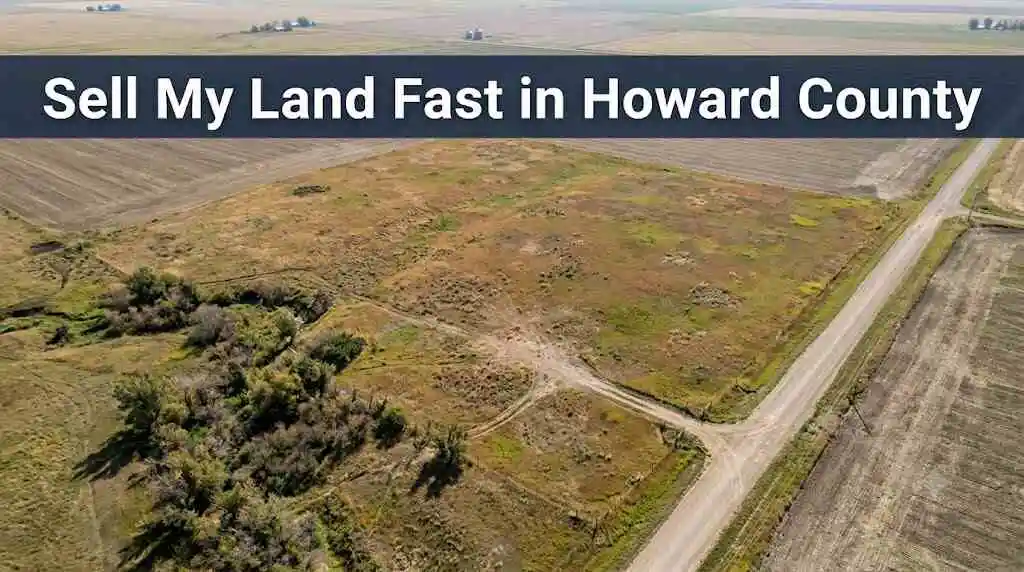
Searching for a way to sell my land fast in Howard County usually means something is pushing you to act: an inherited parcel you never asked for, tax bills that keep coming, or acreage you manage from another state. Land sells differently from a house, and Howard County, Maryland, adds local rules of its own. This guide walks through title, zoning, septic, taxes, buyer types, and area differences so you can move quickly without accepting a poor deal.
Tax and fee figures below were checked in October 2026 against the Maryland Comptroller, Howard County Finance, the Maryland Department of Legislative Services, and SDAT.
Key Takeaways
- Speed comes mostly from clean title and complete records, not from advertising.
- Zoning, septic approval, and any preservation easement decide who can buy your parcel and what they will pay.
- Cash buyers close quickest, but their offers typically land below what a patient, well-marketed sale can reach.
- Buyers will ask about road access, utilities, perc status, and floodplain. Answer those questions before they do.
- Budget about 2.25% of the price for state and county transfer tax plus recordation tax. Farmland leaving agricultural use and out-of-state sellers face extra charges.
- Most land sells as-is. Put your effort into paperwork and a few cheap prep steps, not costly improvements.
- Verify every buyer, read the deposit and exit terms, and close through a reputable Maryland title company.
How to Sell My Land Fast in Howard County: The Short Answer
With a clear title, a cash buyer can often close within roughly two to four weeks, since land-buying companies commonly promise offers within days and closings in 14 to 30 days. A traditional listing usually takes several months, and parcels with title, access, or septic questions can take longer still. The quickest path is to settle ownership and paperwork first, check zoning and septic status, price from nearby comparable sales, and compare at least two offers. Expect to trade some price for the fastest route.
Why Land Moves Differently Than a House
A vacant parcel has nothing to stage and no rooms to tour, and the buyer pool is smaller. Purchasers are mostly builders, investors, farmers, adjoining owners, and families planning to build, and nearly all of them research a parcel carefully before committing.
Howard County also splits into two very different markets. Suburban areas around Columbia and Ellicott City sit alongside a protected Rural West where farming and low-density zoning govern what can be built. A small lot in one and acreage in the other draw different buyers on different timelines. A well-documented parcel can go under contract in weeks, especially if you sell land for cash in Howard County to an investor, while one with ownership gaps, septic doubts, or an inflated price can sit for months. The real decision is how much price you will give up for speed, and which problems you can fix before listing.
Get Title and Paperwork Straight First
Buyers and title companies run the same checks, so run them yourself before anyone else does.
- Deed and legal description: The seller’s name must match the deed, and the description must match the parcel being offered.
- Parcel record: Pull the parcel from the SDAT Real Property Search to confirm acreage, owner, tax status, and any agricultural assessment.
- Liens and back taxes: Old loans, judgments, and unpaid property taxes must be paid off at or before closing.
- Easements and access: Confirm legal road access and note any utility, drainage, or preservation easements.
- Survey: A dated or missing survey invites boundary disputes. Ordering a new one early avoids last-minute delay.
- Covenants and dues: If the parcel is inside a subdivision, collect the restrictions and any association fees.
Ask a local title company to search the title before you list. Problems surface while you can still fix them, at a cost far below losing a buyer in week three. If the deed still carries a deceased owner’s name, open the estate right away, because nothing else can proceed until ownership is settled.
Zoning and Preservation Easements
Zoning shapes your buyer pool more than most owners expect. Much of western Howard County falls under Rural Conservation (RC) and Rural Residential (RR) zoning, which favors farming and low-density housing, and density and cluster exchange options can shift allowed housing between parcels. Check the county zoning map for your parcel and confirm permitted uses with the Department of Planning and Zoning.
Preservation easements matter even more. More than 23,100 acres in the county are protected by state or local agricultural easements, and those restrictions are perpetual and bind every later owner. If your land is already under one, say so upfront; your realistic buyers become farmers, estate buyers, and conservation-minded purchasers. If you own 20 acres or more with development capacity, the county can also buy an easement, paying up to $40,000 per acre. That route is slow, so treat it as a long-term alternative rather than a quick exit.
Whatever the zoning allows, whether building, subdividing, or farming, tells buyers what the land is worth to them. Parcels they can use as planned sell faster and for more.
Septic, Perc Tests, and Wells
Many rural parcels rely on a private well and septic system rather than public water and sewer, which makes septic approval one of the biggest value drivers on raw land. The county Health Department’s Well and Septic Program handles percolation testing, which measures whether the soil can absorb a septic system’s output. Some tests must be done in specific wet-weather windows, so ask about timing early. A passing result helps, but it does not guarantee a house of any size will fit, since soils, slope, drainage, and nearby wells all play a part.
A perc test is not required to sell. Still, a parcel with a passing result, or at least a clear plan to get one, removes the largest unknown in a buyer’s mind. If time is short, tell buyers plainly what has and has not been tested.
Floodplain, Wetlands, and Environmental Limits
Streams, wetlands, steep slopes, and floodplain can restrict where anyone can build. The 2016 and 2018 flash floods in Ellicott City made flood risk a first question for many Howard County land buyers. Check your parcel on the FEMA flood maps and the county’s mapping tools, and be candid about low or wet areas. Forest conservation and stream buffer rules can also limit clearing, so ask the county before a buyer does.
Price From Real Sales, Not Hope
Pricing is where many quick-sale plans fall apart. A tax assessment is useful context but is not market value, and it can sit well above or below what a buyer will pay.
Study recent sales of similar vacant parcels nearby, comparing acreage, zoning, frontage, septic status, utilities, floodplain, and distance to Columbia, Route 29, I-95, and I-70. Small differences in any of these can move the price noticeably. For a quick land sale in Howard County, price toward the lower-middle of your range: a well-priced parcel draws its strongest interest in the first two weeks, while an overpriced one lingers and eventually sells for less after repeated cuts.
Selling As-Is: What Prep Is Worth Doing
You do not need to clear the land. Buyers expect vacant parcels in their natural state, and big spending on clearing or fencing rarely returns at closing. A few inexpensive steps still help:
- Haul away trash and dumped debris, since a littered lot looks neglected and attracts lower offers.
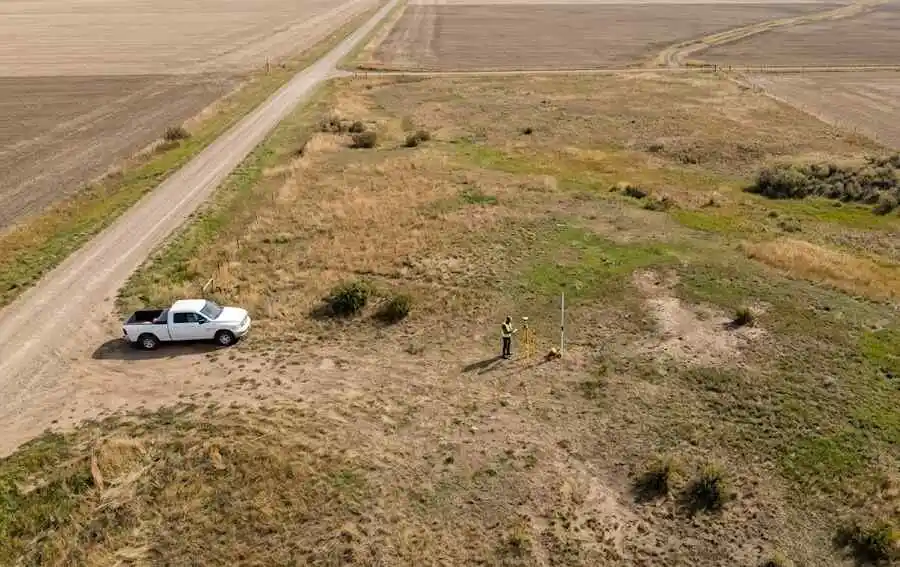
- Mark the corners with stakes or flagging tape so buyers can picture the boundaries.
- Add drone photos that show acreage, tree cover, and frontage better than ground-level shots.
- Prepare a one-page fact sheet listing acreage, parcel ID, zoning, access, septic status, floodplain notes, and tax status.
As-is does not mean silent. Disclose known issues such as boundary disputes, easements, wetlands, or unpaid taxes. A problem found later nearly always costs more than honesty now.
Your Selling Options Compared
Every route trades speed against price. This table puts the main choices side by side.
| Route | Typical speed | Price outlook | Best when |
| Cash buyer or land investor | Fastest; often a few weeks | Usually below market; no commission, little prep | You need certainty and a quick close |
| Land-focused agent (MLS) | Moderate; often months | Closer to market; commission is typically paid by seller and negotiable | You want a stronger price and can wait |
| Auction | Fixed by auction date | Varies widely | The parcel is unusual or hard to price |
| For sale by owner | Slowest and least predictable | Market value, no commission | You have a likely buyer or time to manage the process |
| Owner financing | Can attract buyers fast | Often full price, paid over time | You can wait for your money |
If you pick a cash buyer, ask for written proof of funds and a short list of recent closings; a legitimate company shares both readily. Then read the contract for the deposit size, inspection period, and any right to walk away. Some offers look generous but pair a tiny deposit with a long window that lets the buyer renegotiate or exit. If the number seems low, ask how it was calculated and compare it with recent sales and a second offer.
If you pick an agent, choose one who focuses on land. Listing on the Bright MLS puts your parcel in front of builders and other agents, and Howard County land buyers respond best to listings that spell out zoning, septic status, access, and easements, details many general agents skip.
Owner financing widens the buyer pool but adds legal duties and real risk if the buyer stops paying, so speak with a real estate attorney first. Whatever you choose, gather at least two offers or opinions so you can tell whether a quote is fair.
Where to List If You Sell It Yourself
- Land-focused sites such as LandWatch and Land.com reach people shopping specifically for acreage.
- The MLS, through a flat-fee service or traditional agent, reaches builders and agents.
- Facebook Marketplace and local groups cost nothing and reach nearby buyers.
- A roadside sign is cheap and effective for rural frontage.
- Neighbors, farmers, and builders are worth a direct call; adjoining owners often want more land, and builders keep lists of lots they would buy.
A Realistic Timeline
These are planning ranges, not promises. Your parcel, buyer, and market will shift them.
| Stage | Cash-buyer route | Listing route |
| Paperwork and title check | Days 1–7 | Weeks 1–2 |
| Zoning, septic, and flood notes; pricing | Days 3–7, alongside paperwork | Weeks 1–2 |
| Prep, photos, and marketing | Minimal; share fact sheet | Weeks 2–3 |
| Offers to signed contract | Days 5–14 | Often 3–12+ weeks, depending on price and demand |
| Due diligence and title work | About 1–2 weeks | About 3–6 weeks |
| Closing and deed recording | Total of roughly 2–4 weeks | Total of roughly 3–6+ months |
Most delays trace back to the first two rows, so a week spent on title and records can save a month later.
Selling in Tough Situations
A complicated situation rarely blocks a sale. It mostly adds steps.
Inherited land
In Maryland, the estate generally must be opened and a personal representative appointed before the land can be sold, and heirs with an interest may need to agree. An attorney can confirm who has authority to sign.
Back taxes and liens
Unpaid taxes and liens do not stop a sale; they are normally paid out of the proceeds at closing using payoff figures from the county and each lienholder. If the parcel went through a tax sale, you may still be able to redeem it until a court cuts off that right, and costs keep growing while you wait, so request current figures early.
Divorce or co-owners
Every owner on the deed generally must sign. If co-owners disagree or a divorce decree controls the property, an attorney or court order may be needed.
No legal road access
Landlocked parcels are harder to sell because buyers need legal access. Look for an existing easement or ask a neighbor about creating one. Without access, your realistic buyers are often adjoining owners or investors, and the price will reflect that.
Out-of-state owners
You can often sell without traveling. A title company can usually coordinate signing, notarization, and recording remotely. The main surprise is Maryland’s nonresident withholding, covered next.
Taxes and Costs to Expect
Maryland layers several charges onto a land sale, so plan for them before accepting an offer. For a deed in Howard County, the core three are:
- State transfer tax: 0.5% of the price.
- Howard County transfer tax: 1.25% of the price.
- Recordation tax: $2.50 per $500, which equals 0.5%.
Together that is about 2.25% of the price. Buyer and seller customarily split these, but who pays is negotiable, so settle it in the contract.
Agricultural transfer tax. If land assessed for agricultural use leaves farm use after the sale, Maryland adds a separate tax on the deed: 5% for 20 acres or more, 4% for unimproved land under 20 acres, and 3% for improved land under 20 acres. The amount drops by 25% for each consecutive year the land was taxed on a non-agricultural basis, and SDAT adds a 25% surcharge on the resulting tax. The deed cannot be recorded until it is paid, so agree in writing who covers it and ask the SDAT office for a calculation before closing.
Nonresident withholding. For sales after June 30, 2025, Maryland withholds 8.75% for nonresident individuals and 8.25% for nonresident entities, and the deed cannot be recorded until the payment is made. Think of it as a prepayment of your Maryland income tax rather than an extra fee. You may be able to reduce or avoid it by applying on Form MW506AE through the Comptroller.
Income tax. Federal capital gains rules apply to your profit, and Maryland taxes the gain as income with a local county tax added. Higher-income sellers may owe an additional 2% Maryland surtax on net capital gains. Inherited land often has a different tax basis, so raise that with your CPA.
Other closing costs usually include agent commission (only if you use one, and negotiable), title and settlement fees, the owner’s title policy (who pays is a contract term), a survey if the contract requires a current one, prorated property taxes, and any payoffs for back taxes or liens. Ask your title company for a rough net sheet early. Seeing what you will actually take home makes every offer easier to judge.
Net Proceeds Example
The table below is a hypothetical $300,000 parcel with no agricultural assessment. The commission, 15% cash-offer discount, title fees, and back-tax payoff are assumptions for illustration, and the sellers here pay all three taxes.
| Line item | Agent listing | Cash offer |
| Sale price | $300,000 | $255,000 (15% below) |
| Agent commission (5% assumed) | −$15,000 | $0 |
| State transfer tax (0.5%) | −$1,500 | −$1,275 |
| County transfer tax (1.25%) | −$3,750 | −$3,188 |
| Recordation tax ($2.50 per $500) | −$1,500 | −$1,275 |
| Title and settlement fees (assumed) | −$1,500 | −$1,500 |
| Back-tax payoff (assumed) | −$4,000 | −$4,000 |
| Estimated net to seller | $272,750 | $243,763 |
In this example the listing nets roughly $29,000 more, but only after months of waiting and carrying costs. A cash offer closer to market value narrows that gap, which is why comparing offers matters. If the seller lived out of state, Maryland could hold up to 8.75% of a $300,000 payment, or up to $26,250, at closing as a prepayment against that seller’s Maryland tax, unless an exemption certificate reduces it.
How Your Part of the County Changes the Sale
Demand is not uniform across Howard County. Use the pattern below to decide whom to market to and what to emphasize. It is a general guide, so confirm the details for your parcel.
| Area | Likely buyers | What drives value | Speed outlook |
| Columbia, Ellicott City, and nearby suburban areas | Builders, infill investors, local families | Public water and sewer, zoning, flood risk near streams, infill potential | Generally faster when zoning supports building |
| Elkridge, Jessup, Fulton, and Savage | Investors, builders, commuters seeking access to major routes | Access to I-95 and Route 29, utilities, permitted uses | Moderate to fast with clear permitted uses |
| Rural West: Glenelg, Woodbine, Lisbon, West Friendship, Marriottsville | Farmers, estate buyers, families wanting acreage, conservation buyers | RC or RR zoning, perc and well status, preservation easements | Slower; depends heavily on septic status and easements |
In your listing, describe the surrounding land use and any nearby development, because buyers near Columbia and farmland buyers around Glenelg or Lisbon weigh very different things.
Scams and Lowball Offers
Landowners who search “sell my land fast in Howard County” often draw unsolicited letters and calls, and vacant land is a favorite target because no one lives there to notice trouble. Some of these buyers are legitimate; many simply fish for deep discounts. Check the company’s reviews, business address, and closing history, and ask for a sample contract before sharing much.
Treat these as red flags:
- Pressure to sign within a day or two.
- A small deposit paired with a long window and an easy exit for the buyer.
- A buyer who avoids or refuses a title company.
- Upfront fees, or wire instructions emailed at the last minute.
- An offer far above or below your land’s value with no explanation.
Before wiring money or sharing documents, call the title company at a number you looked up yourself. One call has stopped many wire-fraud attempts.
Mistakes That Cost Sellers Time and Money
- Listing before a title search, then discovering a lien during the contract period.
- Assuming the land is buildable without checking zoning and septic.
- Taking the first cash offer without a comparison.
- Letting flood, wetland, or access problems surface during due diligence instead of disclosing them.
- Learning about agricultural transfer tax or nonresident withholding only at the closing table.
- Signing a contract no attorney or title company has reviewed.
Frequently Asked Questions
How fast can I sell vacant land in Howard County?
A cash sale with clean title can close in a few weeks. A traditional listing commonly takes several months. Because cash buyers move quickest and agents usually achieve better prices, get both kinds of opinion so you can weigh speed against price.
Can I sell land in Howard County without a realtor?
Yes. Maryland does not require an agent for a private sale. You should still use a title company or attorney for closing and deed recording, because easements, zoning, and boundaries carry real weight on raw land.
Who buys land for cash in Howard County?
Investors, builders, developers, farmers, and neighbors all pay cash. Ask for proof of funds, review their closing history, and route the money through a title company. Compare more than one offer before accepting.
How much are transfer taxes when selling land in Howard County?
State transfer tax is 0.5%, the county adds 1.25%, and recordation tax is $2.50 per $500 (0.5%), for roughly 2.25% of the price. Buyer and seller usually split them, though that is negotiable. Land leaving agricultural use can owe agricultural transfer tax as well. Your title company can supply current figures.
Can I sell inherited land in Howard County, MD?
Yes, once someone holds legal authority to sell, usually a personal representative appointed through the estate. Multiple heirs, unpaid taxes, or title problems add steps but do not necessarily stop the sale, and taxes owed are normally paid from the proceeds at closing.
Bottom Line
To sell my land fast in Howard County without regret, fix the paperwork before marketing, understand your zoning and septic status, price from real sales, and compare at least two kinds of buyers. Speed comes from preparation, not pressure. Expect buyers to ask about floodplain, easements, and taxes, and have the answers ready.
If you choose a cash buyer, verify the company and close through a title company. If you want a higher price and can wait, a land-focused agent is usually the better fit. Either way, one conversation with a title company and a tax professional now can save far more than it costs.